

Article
For most high-earning executives, successful entrepreneurs, and accomplished professionals across the United States, achieving a multi-million-dollar portfolio feels like the ultimate finish line. After decades of disciplined investing, maximizing qualified retirement plans, and building substantial home equity, the financial numbers on paper suggest complete security.
Yet, as thousands of affluent Americans discover every year, accumulating wealth is fundamentally different from navigating a successful retirement.
When you step away from a demanding career or exit a business, financial readiness alone doesn't guarantee peace of mind. High-net-worth individuals (HNIs) face a complex web of interconnected challenges: tax-efficient income sequencing, estate fragmentation, healthcare surcharges, and an unexpected psychological hurdle known as the "purpose gap." Traditional wealth management tools, designed almost exclusively around asset accumulation and stock portfolios, leave these critical lifestyle and legacy needs entirely unaddressed.
To build a retirement that's truly fulfilling, resilient, and enduring, pre-retirees need to look beyond raw account balances. By evaluating retirement through a holistic, multi-dimensional framework, and leveraging early-access planning innovations like the Retirelens Alpha Program, affluent households can systematically align their wealth, health, legacy, and daily purpose.
The Wealth Paradox: High Assets, Complex Blind Spots
Data from the Federal Reserve Survey of Consumer Finances demonstrates that while the top 10% to 20% of American households control the vast majority of private financial assets, financial abundance frequently masks deep operational vulnerabilities in retirement execution. Having $3 million, $5 million, or $10 million in accumulated wealth doesn't automatically solve the operational friction of drawing down that wealth efficiently.
In fact, higher net worth introduces unique complexities that standard financial software fails to handle:
• The Tax Drag Cliff: Holding substantial assets across taxable brokerage accounts, traditional tax-deferred IRAs/401(k)s, and Roth accounts requires precise yearly withdrawal sequencing. Mismanaging required minimum distributions (RMDs) or missing strategic Roth conversion windows can result in top-tier marginal income tax rates and elevated Medicare surcharges.
• The "Phased Retirement" Shift: Recent research by Fidelity Investments reveals that 61% of working Americans with retirement accounts no longer view retirement as a hard, single-day exit. Instead, 72% plan to retire on their own terms through consulting, advisory roles, or phased schedule reductions. Traditional retirement models built around rigid, single-date portfolio liquidation are completely ill-suited for these dynamic income streams.
• The Purpose and Identity Vulnerability: High-performing professionals derive a significant portion of their identity, daily structure, and social engagement from their work. When that career ends, the sudden absence of a structured calendar can create profound disorientation: a transition challenge that no brokerage statement can resolve.
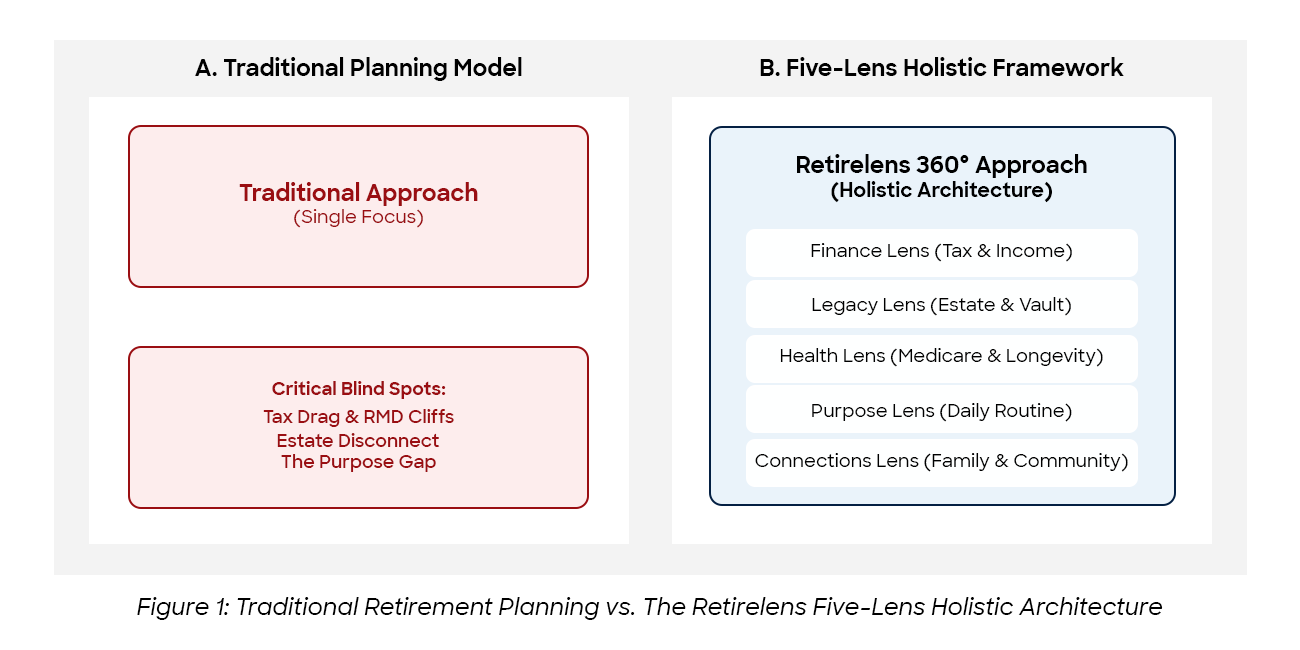
The Five Critical Friction Points in Affluent Retirement
When wealth managers focus solely on market returns, critical life decisions fall through the cracks. High-net-worth pre-retirees consistently encounter five major friction points during their transition out of the full-time workforce.
1. Tax-Aware Drawdown and Income Sequencing
In accumulation mode, the goal is straightforward: save as much as possible in tax-advantaged vehicles. In distribution mode, the math flips entirely. Deciding which bucket to draw from first (taxable, tax-deferred, or tax-free) directly dictates how long your wealth lasts and how much you pass on to heirs. For the account-level mechanics behind that split, see Retirelens' comparison of IRA and 401(k) accounts.
Comprehensive research from Vanguard illustrates that implementing a tax-efficient, multi-bucket drawdown strategy (incorporating deliberate Roth conversions during lower-income gap years) can preserve substantial wealth over a retiree's lifetime. Without dynamic coordination, retirees risk pushing themselves into higher federal tax brackets and incurring Medicare Income-Related Monthly Adjustment Amount (IRMAA) premium spikes.
2. Estate Disconnect and Legacy Realities
Most affluent families have executed baseline estate documents: wills, revocable living trusts, durable powers of attorney, and healthcare proxies. However, these documents are frequently drafted once, stored in a physical cabinet, and forgotten.
Over time, asset titles change, new accounts are opened, family dynamics evolve, and executor contact details become outdated. When a health crisis occurs, family members are left searching through physical paperwork or guessing at intent. True legacy planning requires keeping structural asset lists, digital account access instructions, and personal directives organized, updated, and accessible to loved ones when needed. Retirelens' Legacy Lens flow walks through exactly this inventory, document by document.
3. Healthcare Inflation and Longevity Risk
While high-net-worth retirees can generally cover standard medical costs, medical inflation and long-term care events represent unmanaged liabilities. Medicare doesn't cover extended custodial care, and supplemental coverage options vary widely in scope.
As life expectancy increases, planning for a 30- or 35-year retirement requires stress-testing portfolios against prolonged market volatility and compounding healthcare costs.
4. The "Purpose Gap" and Daily Structure
For decades, your professional career dictated when you woke up, what problems you solved, and who you interacted with every day. Leaving that environment creates a sudden vacuum of time and routine.
Without an intentional plan for how to spend 2,000+ newly available hours each year, many retirees experience post-retirement slump. Designing a satisfying post-work lifestyle requires proactive planning around passion projects, mentorship, board positions, travel, and personal hobbies.
5. Community Decay and Social Architecture
Workplaces provide an implicit social network. Once you retire, maintaining meaningful connections requires deliberate effort. Studies in healthy aging consistently show that strong social ties and multi-generational family involvement are just as vital to longevity and cognitive health as physical exercise or financial security.
The Numbers That Change at This Asset Level
Much of the standard retirement advice is written for a household where the binding constraint is whether the money lasts. Above roughly $5 million that constraint is usually gone, and a different set of thresholds starts driving decisions, none of which appear in a typical projection.
• Medicare surcharges. IRMAA runs on a two-year lookback, so income recognized in 2026 sets your 2028 premiums. The brackets are cliffs, not slopes: a single dollar over a threshold moves you up for the entire year. That makes the timing of a conversion, a business sale, or an invoice a genuine planning lever.
• The net investment income tax. An additional 3.8% applies to investment income above the statutory thresholds, which interacts with capital gains realization and with how you sequence taxable withdrawals.
• RMD stacking. Large tax-deferred balances produce required distributions that can push you into a higher bracket in your seventies whether you need the income or not. The gap years before RMDs begin are the cheapest tax years you'll ever have, and they're finite.
• Estate exemption drift. Federal exemption levels are legislated and subject to change. A plan built around today's exemption is a plan with an expiry date attached, and most families never revisit it.
None of these are exotic. They're just invisible to software built around the single question of portfolio survival. Model your own exposure with the RMD calculator before assuming the answer.
What the Five Lenses Look Like in Practice
A worked example makes the interconnection concrete. Consider a 62-year-old who has just sold a business and is deciding whether to take a two-year advisory role at the acquirer.
• Finance. The advisory income closes two of the low-bracket years available for Roth conversions before RMDs begin. That's a real cost, and it needs to be netted against the fee rather than counted alongside it.
• Health. Staying on employer coverage bridges to 65 cleanly. It also means confirming in writing that the plan is creditable before delaying Part B, because the late-enrollment penalty is permanent.
• Purpose. The advisory role supplies structure and status for two more years. It also defers the transition rather than resolving it, which means the same problem arrives at 64 with less runway.
• Connections. Two more years inside the building preserves the professional network but does nothing to build the one that has to replace it. Positional ties don't survive the second exit either.
• Legacy. A liquidity event changes the estate picture immediately. Asset titles, beneficiary designations and trust funding all need revisiting within months, not at the next scheduled review.
Run those five separately and the advisory role looks straightforwardly good. Run them together and it's a genuine trade with costs on both sides. That's the case for looking through all five Lenses at once rather than sequentially: the decision doesn't change, but the quality of it does. Score where you currently stand with the Retirelens area self-assessment, since Purpose and Connections are the two Lenses most often left unmeasured.
The Five-Lens Framework: A Modern Architecture for Retirement
To eliminate these blind spots, Retirelens was built around a comprehensive Five-Lens Framework. By viewing retirement readiness through five distinct, interconnected Lenses, pre-retirees can transform an overwhelming transition into a structured, manageable process. Start with the Finance Lens flow to see where your own numbers stand before working through the other four.
| Planning Lens |
Core Focus |
Key Questions Answered |
| Finance Lens |
Income sequencing, tax optimization, and asset longevity |
How do I optimize withdrawals across my accounts to minimize taxes and ensure my money outlasts me? |
| Health Lens |
Healthcare coverage, Medicare planning, and wellness |
What are my projected healthcare costs, and how do I protect my physical vitality in retirement? |
| Purpose Lens |
Daily structure, consulting, and post-career goals |
What will give me a sense of daily drive, structure, and fulfillment once my core career concludes? |
| Connections Lens |
Social networks, family ties, and community involvement |
How will I build and maintain strong social connections and support systems as my lifestyle shifts? |
| Legacy Lens |
Estate organization, wealth transfer, and family directives |
Are my wills, trusts, and asset wishes organized so my family isn't left guessing during a crisis? |
Taking "Small Moves" Toward Readiness
One of the greatest barriers to retirement planning for busy executives and business owners is the sheer magnitude of the task. Attempting to address taxes, estate planning, health coverage, and lifestyle design in a single weekend leads to decision fatigue.
The Five-Lens approach breaks down complex decisions into intuitive, step-by-step actions, termed "small moves." Rather than demanding flawless, hyper-precise financial estimates on day one, the platform allows users to start with high-level projections and progressively refine their details over time.
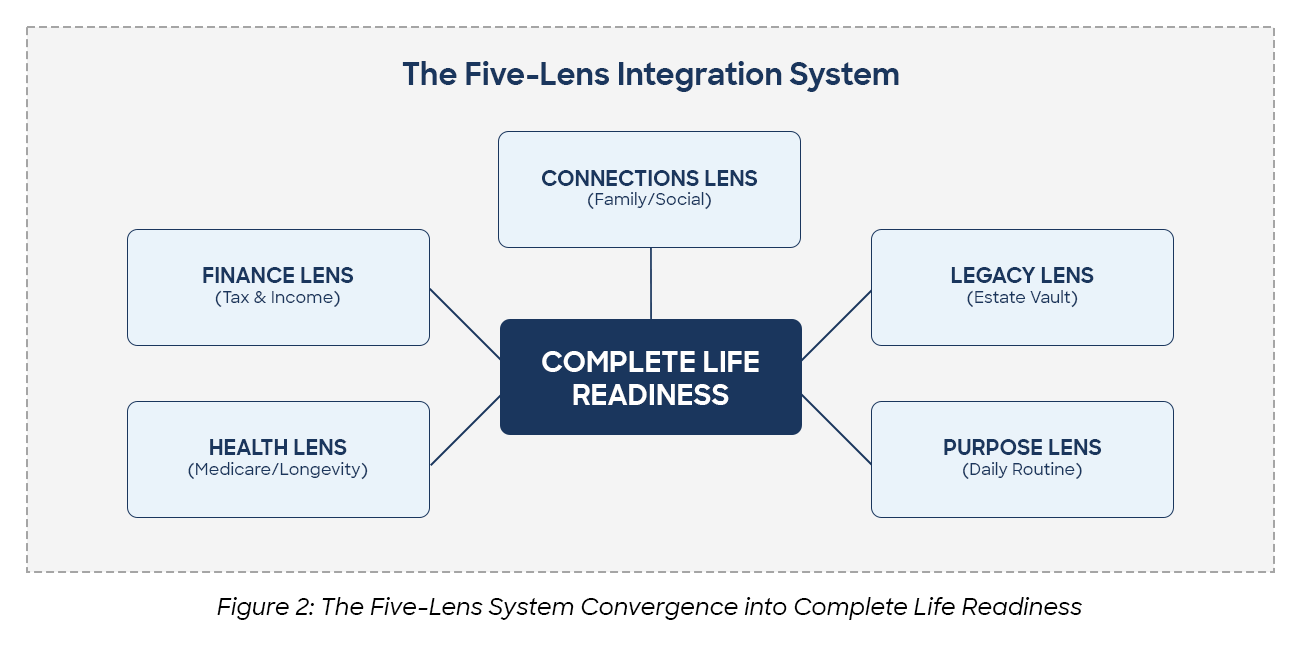
Why Traditional Advisory Tools Fall Short, and What Is Changing
A fundamental problem with traditional financial software is what behavioral researchers call the "curse of knowledge." Financial platforms are typically built by quantitative analysts for financial advisors. They flood users with dense Monte Carlo probability charts, complex asset correlation matrices, and technical jargon that obscures actionable decision-making.
What high-net-worth individuals actually need is an intuitive, central dashboard that unifies their financial, estate, and lifestyle planning into a clear, actionable roadmap. They need software that answers practical questions:
• "If I execute a $100,000 Roth conversion this year, how does that impact my tax bracket and Medicare premiums three years from now?"
• "If my primary trust was executed in 2018, what gaps exist between my current asset titles and my legal beneficiaries?"
• "How can I structure a phased consulting schedule that generates supplemental income while giving me freedom to travel?"
By leveraging modern software design and secure AI capabilities, digital platforms can now synthesize complex financial rules into clear, personalized insights, guided scenarios, and structured reminders.
Experience the Future of Planning: The Retirelens Alpha Program
To solve this challenge, Retirelens has launched an exclusive, early-access initiative: the Retirelens Alpha Program.
Designed specifically for forward-thinking pre-retirees, retirees, and affluent families, the Alpha program gives participants early access to a new generation of holistic retirement tools before general public release.
KEY FEATURES AVAILABLE IN THE RETIRELENS ALPHA
• Interactive Readiness Assessments: Comprehensive, guided evaluations across the Finance and Legacy Lenses to identify blind spots in your current plan.
• Advanced Financial & Tax Calculators: Access to built-in tools for evaluating 401(k) longevity, safe withdrawal rates, Roth conversions, RMD schedules, Social Security claiming strategies (comparing ages 62, 67, and 70), and inherited IRA tax impacts.
• Structured Document Vault & Document Q&A: Centralize key estate documents, wills, policies, and directives in one secure location with integrated AI features to summarize key terms and highlight missing details.
• Direct Co-Creation Influence: Provide feedback directly to the product engineering team to shape upcoming modules, including the Health, Purpose, and Connections Lenses.
Privacy, Security, and Uncompromising Trust
Planning for retirement involves sensitive personal, financial, and family information. The creators of Retirelens operate on a foundational belief that retirement planning requires absolute privacy and transparency.
Under the Retirelens Privacy Policy and early-access terms:
• Zero-Sale Privacy Guarantee: Retirelens never sells or shares your personal information with third parties. Their business model is built entirely on serving users, not monetizing data.
• No Targeted Advertising: Your financial assets, estate details, and planning inputs are never used to serve targeted advertisements.
• Bank-Level Security: Information is safeguarded using enterprise-grade encryption both in transit and at rest.
• Zero Cost Commitment: Participation in the Alpha program is completely free, requires no credit card, and carries no automatic paid subscription conversions.
Frequently Asked Questions
Does a large portfolio remove the need for retirement planning?
It removes the question of whether the money lasts and leaves the harder ones intact: tax sequencing, estate currency, healthcare exposure, and what the days are actually for. Financial readiness alone doesn't produce a retirement that works.
Why do high performers struggle more with the transition?
Because the role was carrying more of their identity and supplying more of their daily structure. The more of your calendar that was set by other people, the larger the gap when it stops.
How often should estate documents be reviewed?
Whenever the underlying facts change (a liquidity event, a new account, a move between states, a change in family circumstances), and otherwise every three to five years. Documents drafted once and filed away drift out of alignment with asset titles surprisingly fast.
What is long-term care likely to cost?
Medicare generally doesn't cover custodial care, so it sits outside standard medical planning. Size the exposure explicitly for this rather than treating it as a contingency. Retirelens' guide to long-term care insurance breaks down the coverage gap in detail, and dedicated long-term care and healthcare cost calculators (see similar scenario planning here) are in development.
Where should someone start if all five Lenses need work?
With the weakest one, not the most comfortable one. Most people in this position score well on Finance and Health and have never assessed Purpose or Connections at all.
Related Articles
For readers working through specific pieces of this picture in more depth:
• Long-Term Care Insurance: Is It Worth It? covers the coverage gap behind the Health Lens exposure raised above.
• IRA vs. 401(k): Which Account Wins for Your Situation? breaks down the account mechanics behind tax-aware drawdown sequencing.
• Case Study: How Jane Bridged the Gap Between Savings and Income walks through one household's income-and-savings bridge in practice.
• Why Retirement Is More Than Just Money makes the case for a fuller view of retirement beyond the balance sheet.
Take Control of Your Retirement Transition Today
Retirement shouldn't be a leap into the unknown, nor should it be confined to a static financial spreadsheet. You've worked hard to build your wealth; now is the time to build a comprehensive plan that protects your financial security, organizes your legacy, and enriches your daily life.
Explore the platform, test your financial and estate readiness, and help shape the future of holistic retirement planning.